> For the complete documentation index, see [llms.txt](https://docs.ox.security/llms.txt). Markdown versions of documentation pages are available by appending `.md` to page URLs; this page is available as [Markdown](https://docs.ox.security/ox-integrations/3rd-party-integrations/registry/google-artifact-registry-overview.md).
# Google Artifact Registry
Google Cloud Artifact Registry (GAR) is a unified registry service for managing and securing software artifacts.
GAR offers:
* **Centralized hosting** for multiple artifact types like Docker images, language-specific packages (Maven, npm, Python) and OS packages.
* **Granular access control** through Cloud IAM.
* **Direct integration with Google Cloud's deployment services**, such as Cloud Run and Google Kubernetes Engine (GKE).
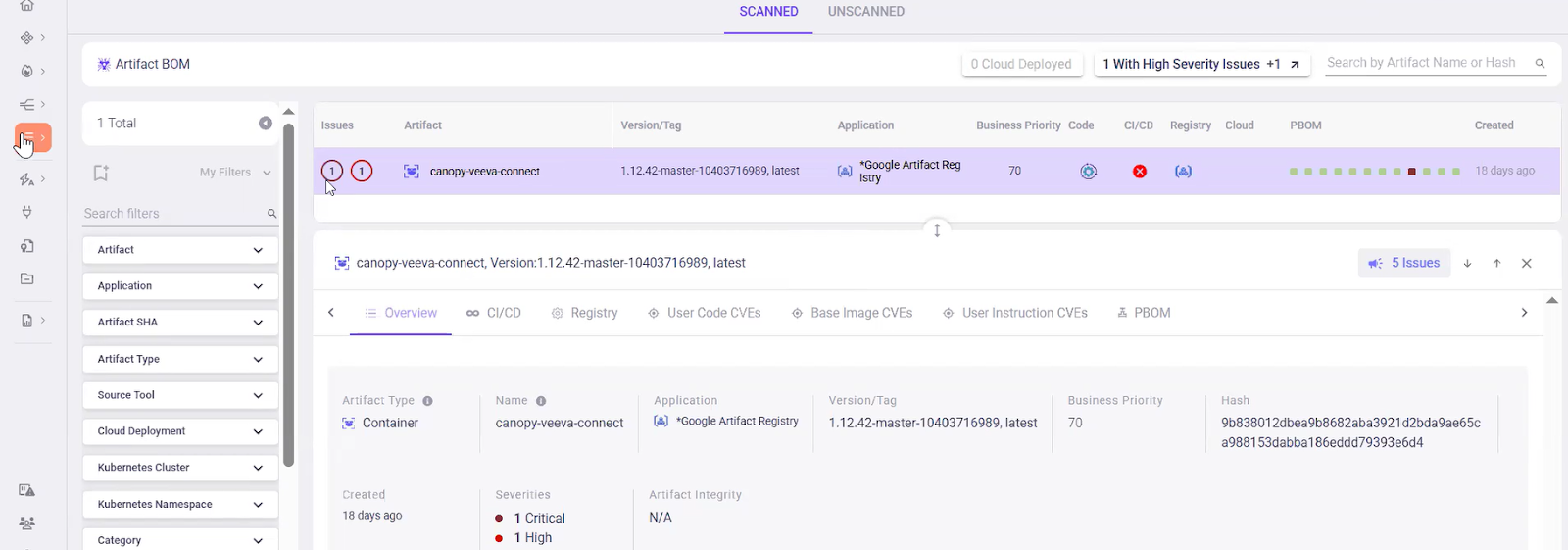
By connecting GAR to OX Security, you have a constant connection to GAR and scanned results are displayed in the Artifact’s BOM. OX Security scans the Docker images in every Artifact Registry location of the project you connect.
## Connection methods
| Method | How it works |
| -------------------------------------------------------------------------------------------------------------------------------------------------------- | -------------------------------------------------------------------------------------------------------------------------------------------------------------------------------------- |
| [Token & Project ID](https://docs.ox.security/ox-integrations/3rd-party-integrations/registry/google-artifact-registry-overview/token-project-id.md) | Connect one GCP project at a time using a Base64-encoded service account JSON key. Create a separate OX connection for each project; credentials can be reused when permissions allow. |
| [Service Account Hub](https://docs.ox.security/ox-integrations/3rd-party-integrations/registry/google-artifact-registry-overview/service-account-hub.md) | Use one centralized service account connection to discover accessible GCP projects and scan Docker images across them. |
Both methods require OX admin permissions, a service account key, and appropriate Google Cloud IAM access. The Cloud Resource Manager API must be enabled in the service account's project.
**Note:** GAR can store Maven, npm, Python, and other packages, but this connector scans Docker images.
---
# Agent Instructions
This documentation is published with GitBook. GitBook is the documentation platform designed so that both humans and AI agents can read, navigate, and reason over technical content effectively. Learn more at gitbook.com.
## Querying This Documentation
If you need additional information that is not directly available in this page, you can query the documentation by asking a question.
Perform an HTTP GET request on the following URL with the `ask` and `goal` query parameters:
```
GET https://docs.ox.security/ox-integrations/3rd-party-integrations/registry/google-artifact-registry-overview.md?ask=&goal=
```
`ask` is the immediate question: it should be specific, self-contained, and written in natural language.
`goal` is what the user is ultimately trying to achieve, the reason they need the answer. Sharing it helps GitBook give you a better, more relevant answer. A goal is most helpful when it describes the outcome the user wants rather than restating the question. For example, with `ask=how do I create an API token`, a goal like `automate deployments from our CI pipeline` lets GitBook tailor the answer to that use case.
The response will contain a direct answer to the question and relevant excerpts and sources from the documentation.
Use this mechanism when the answer is not explicitly present in the current page, you need clarification or additional context, or you want to retrieve related documentation sections.